Tuesday, September 15, 2015

European Vans: Part 2

In my last blog, I analyzed some of the vans that I saw on my recent trip to Italy. Here, in Part 2, are the rest:

Renault/Nissan/Opel/Mercedes-Benz
A Renault Master in Sorano
A Nissan NV400 in Verona
Call it the Renault Master, call it the Opel Movano or even Nissan NV400, but by any name, this van still is a bit gawky and awkward. All three are identical and simply rebadged under different names (with a fourth, the Vauxhall in the U.K.); their most prominent feature in the front are the vertically oriented headlights, which look as if they are being pulled upwards by a string attached to the top of the unit. From the side, the headlights are reminiscent of the oversized headlights on the Chevy Spark compact car. These large headlights make the van appear unusually tall, and sometimes a bit unstable, as if a strong gust of wind could blow the top-heavy vehicle over. The headlights on the Nissan are a bit shorter, but the effect remains. The main difference between the three is in the grilles. The Renault grille has three horizontal bars painted in gray, each with four evenly spaced, rectangular holes. The color and the design have a very industrial feel, and give the van a fittingly tough appearance. The Nissan features the corporate grille, which is not nearly as handsome as the Renault, although it is better than the Opel, which has a lackluster chrome bar atop a black mesh grille. 

A 2nd generation Vivaro in Massa Marittima
(I'm not going to discuss the Mercedes-Benz Sprinter, the other competitor in this segment, because it is also sold in the US.) 

A 3rd genereation Vivaro in Venice
Below the Master/Movano/NV400 is the Renault Trafic/Opel Vivaro. Most of the Trafics and Vivaros that I saw were the second generation model, which looks like an alien with its slanted front and large circular headlights that dwarfed the tiny grille. However, there is a much more attractive third generation model that I spotted a few times. While the headlights are still oddly shaped, they are aggressively angled, and connect to the large, bold grille. On the Renault, the grille is all black with horizontally oriented slats. The Opel is a bit more luxurious, with thin chrome horizontal bars. The lower front fascias are also quite different, with the more utilitarian Renault getting a large black plastic bumper, and the upscale Vivaro getting a wide lower intake and shiny black fog lamp housings. On both vans, a very strong character line extends down from the window and runs along the side panels. While not necessarily the most attractive vans, these two cargo-haulers feature a bold and interesting design. 

Vito in Grosseto
In the Mercedes lineup, the Vito slots beneath the Sprinter. The most expensive, and best-looking, passenger version is the V-Class, and it comes with LED lights and chrome-covered front and rear fascias. A cheaper passenger version, called the Vito Tourer is also offered, with basic head and taillights, and on the cheapest trims, an ugly black plastic front bumper. The cargo version, called simply the Vito, features the same plastic bumper as the Tourer, however, it looks a bit more appropriate on the Vito since it is a work vehicle. Whether or not it has the bumper, all of the Vito/V-Class vans look handsome. Every element is proportioned well, and the headlight shape, which is in line with the rest of the Mercedes family, is unique compared to other vans as well as being pleasing to the eye. Strong creases through the door handle and down the side complete the sturdy and striking appearance of the Vito.
Vito Tourer in Florence


For those who need a slightly smaller van, Renault and Mercedes teamed up for the Kangoo and Citan, respectively. Up front, the Renault has simple, round headlights and a black plastic fascia. Chrome inserts and a large silver logo finish off the basic front end. Only the lower front fascia on the Merc is coated in black plastic, lending the van a slightly more luxurious look. A substantially sized grille gives a bolder look to the Benz, but from there back it is nearly identical to its French counterpart. These two vans come in three sizes: compact, long, and extra long. While compact and long look normal, extra long ruins the proportions of the vehicle, distorting the cute appearance of this little van.

In this segment, Opel offers the Combo, which is a rebadged Fiat Dobló. For more on this vehicle, see my previous post on European vans. Nissan's offering in this segment is the NV200, which is sold in America, and is the new staple of New York's taxi fleet, replacing the Ford Crown Victoria.

Volkswagen

Crafter in Florence
At the top of VW's commercial vehicle range is the Crafter, which is based on the Mercedes-Benz Sprinter. However, it has a completely unique front, with tall headlights and a wide grille with three horizontal bars. Like most VWs, the Crafter has many straight lines, and looks handsome, but the way the grille juts out and the way the vertical headlights flow into the hood create a unique front fascia. 

Multivan in Florence
Beneath the Crafter is the T Series, which consists of the Transporter, Multivan, Caravelle, and California. While the  6th generation just debuted, I'm going to focus on the 5th generation models, which is what I saw on the streets of Italy. The Transporter is the most utilitarian van in the range, and is offered in both passenger and cargo versions. The black plastic bumper differentiates it from the other models. The Multivan and Caravelle are more passenger-oriented vehicles, while the California is a full-fledged camper van. All four models feature the same simple rectangular headlights and thin rectangular grille. Despite how simple the VW's front fascia is, they are quite handsome vehicles, and look especially cool with the optional two-tone red and white paint job.

Caddy in Florence
The Caddy, VW's smallest van, also recently got an update, but since it was not yet for sale, I will focus on the pre-facelifted version. While the taillights look really out of date, the headlights and grille provide the classic VW look: as if it was designed using only a ruler. While not exciting, it is predictable and decent looking. 


Dacia
While I was unable to capture a photo of it, I did see a handful of Dacia Dokkers. The Dokker looks awfully similar to their minivan offering, the Lodgy, with it's pointy headlights and wide grille. It came as a passenger and cargo van, as well as a pickup truck. Like all Dacias, it was incredibly simple, and the front fascia was masked in black plastic. However, the triangular headlights added some character the van. 


Hyundai
I saw one Hyundai H350, and it was parked in front of a Hyundai dealership. While sales appear to be slow, it is not a bad looking vehicle. Bold headlights with straight edges and LEDs stand out, and look relatively aggressive. The extremely large grille is also a plus. Although I only one, this is one of the better looking vans that I spotted in Italy. 


And one final note: I did see one American van while in Italy. It was a grey post-facelift Chevy Express, and looked really out of place among the sleek European vans. You can spot it in the background of the photo of the Mercedes Vito.


Wednesday, September 2, 2015

European Vans: Part 1

Fiat Scudo in Sorano
For the majority of my life, America's van market was limited to the boxy offerings from Ford and Chevy. But within the past few years foreign companies, such as Nissan and Fiat (through the RAM brand), have joined the fray. These companies introduced mid-size vans, like the Nissan NV200, as well as European-style full-size vans, to American customers and slowly began eating away at the sales of the American vans. Soon Ford changed its ways, selling its popular European model, the Transit, for the first time in the US, and discontinuing its long running E-Series. But after traveling to Italy this summer, I realized that the United States is still missing out on a large chunk of the global van market. In this post I will outline some of the vans I saw while in Italy, and what I like or dislike about each.


Fiat/Citroen/Peugeot
Fiat Ducato in Verona
Fiat and PSA Peugeot-Citroen share the same basic mechanical and visual elements for the majority of their van fleets. At the top of the range is the Fiat Ducato, Peugeot Boxer and Citroen Jumper triplets. On this side of the pond, it is branded as the RAM ProMaster, although our version has yet to receive the facelift that the European models got for the 2015 model year. The update lessens the third generation's bug-eyed look, and adds a sleek silver grille on the Fiat models. The boxier grille on the Peugeot variants causes the front fascia to look pinched, and the Jumper, known as the Relay in the UK, features a simple plastic grille topped with two silver bars. The Ducato is by far the best looking, and also seemed to be the most popular of the three by leaps and bounds.


Citroen Jumpy in Verona
Slotted below the Ducato is the Fiat Scudo, Citroen Jumpy, and Peugeot Expert. An extremely slanted front end and a bulky plastic bumper makes the vans appear as if they have an underbite, and each variant had its respective company's familial grille. My favorite is the Jumpy, called the Dispatcher in other markets, because the small, chrome grille lessens the effect of the underbite.


Fiat Doblo in Florence
Citoren Berlingo in Pitigliano
For the mid-size segment, Fiat and Peugeot-Citroen use separate designs. Fiat has the Doblò, which is rebranded as the Opel Combo, sold as the RAM ProMaster City in the States, and the Toyota ProAce in other parts of Europe. The Fiat received a facelift recently, and features a thin full-width grille which sit underneath the horizontally oriented headlights. The update brings the model into line with the appearance of the new Ducato, and it causes the model to have an odd, smiling look. Meanwhile, the French twins, the Peugeot Partner and Citroen Berlingo, have a snail-like shape, and feature more traditionally oriented front fascias, with the simple chrome bars of the Berlingo being my favorite.


Citroen Nemo in Sorano
Fiat Fiorino in Grosseto
Fiat and the French brands team up again for the smallest vans. The Fiat, called the Fiorino in cargo spec and the Qubo in passenger trim, and the Citroen Nemo both have no grille, which creates a streamlined appearance. The Peugeot Bipper, on the other hand, has a small grille surrounding the lion logo, which disrupts the clean space between the headlights. All three models are cladded with a massive plastic front bumper. These cute vans were quite popular, especially in the more urban areas I visited.

Ford

Tourneo Courier in Massa Marittima
While in America, Ford is known for the square, boxy, and ugly E-Series, its European van range is composed of aerodynamic, attractive vans. At the bottom of the range are the Transit Courier (cargo) and Tourneo Courier (passenger). These two vans are not sold in America, and have slightly sporty styling due to the corporate trapezoidal grille. These two vans look very aerodynamic and also quite handsome, and were some of my favorite vans that I saw while in Italy.

Next is the slightly larger Transit Connect (cargo) and Tourneo Connect (passenger). These two are sold across the Atlantic too, with only difference being that the Tourneo Connect is referred to as the Transit Connect as well. Next up, is the Transit Custom (cargo) and Tourneo Custom (passenger). These vans are slightly smaller than the full-size Transit, and are front wheel drive instead of rear wheel drive. The grille is more akin to that of the Transit Connect, and the corners of the headlights are pulled back towards the A-pillar, making the van look like it's being stretched backwards by the wind. At the top is the Ford Transit which recently replaced the E-Series in the USA. I found Ford's European van range a bit confusing, especially considering how simple it is in the USA: you can either get a Transit, or a Transit Connect. European customers have much more to choose from, including some particularly good-looking cargo-haulers.


Iveco

Italian truck company Iveco produces a full-sized van called the Daily. While the majority of Dailys that I saw were the bland fifth generation, which features very un-original oval headlights and a rectangular, silver grille, I did spot a few of the new sixth generation models, which quickly became one of my favorite vans. The sixth generation's face is all angles, with a thin, blocky grille, which turns upwards at the ends. The grille runs directly into the aggressively tilted, rectangular headlights.  The robotic Daily stood out among all the smooth lines of the other European vans. 


  European Vans: Part 2 Coming Soon!!!


Tuesday, August 11, 2015

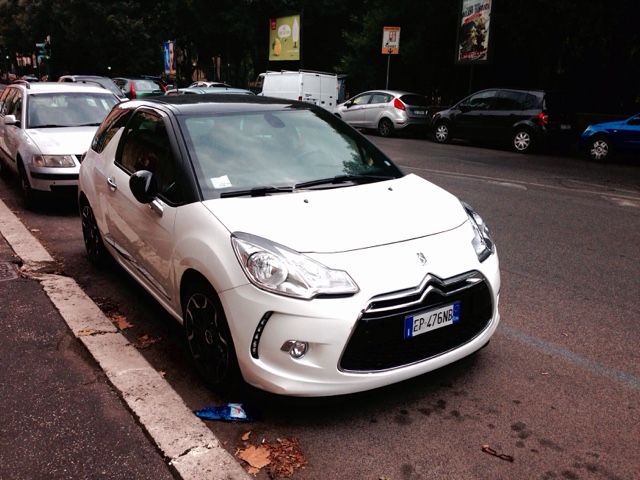
Citroen DS3

The streets of Rome are filled with small, dinky hatchbacks. Smart Fortwos, Fiat Puntos, Dacia Sanderos, and Aixam Citys line the twisting alleys, tucked in the nooks and crannys next to a plethora of scooters and outdoor restaurant tables. Practicality and affordability seem to be more important than pizazz to the citizens of Rome. So although it is still a hatch, and not nearly as expensive as Italy's supercar options, the flashy Citroen DS3 stands out among the cheap Renault Twingos and Ford Fiestas which populate Rome's stradas.

The chrome horizontal strips, which incorporates the Citroen double-chevron, top a bold blacked-out grille. On either side of this athletic trapezoid intake are two sets of running lights chiseled into the bodywork. Closer to the grille are the more typically shaped circular fog lamps, while a fancier vertical LED strip sits nearer to the front wheels. The shallow indents leading into these sets of lights lend the DS3 an aggressive and more upscale appearance. However, the large headlights above make the Citroen look a bit bug-eyed, and could have been a lot sleeker. 
Leading back from the bulging headlights, black mirrors and a black roof cause the white paint to pop. A strong line through the door handles and a crease over the rear wheels add character to otherwise plain side body panels. The chrome oval spanning the bottom of the doors adds a touch of luxury. Finally, the incomplete B-pillar creates a stylish "floating" roof, which is especially impressive since this design element was about 5 years ahead of its time. The floating roof is now a major theme on Lexuses and Nissans. 

The rear features sharp, clean looking semi-square taillights, and a large chrome DS logo. The contrasting black roof adds to the sporty design while chrome coated exhaust contributes to the luxurious aura given off by this hatch. Overall, this French, chrome-laden hatchback stands out among the bland super-minis that surround it in Rome, and would stand out most anywhere in the world.

Grade
Front: A-
Back: A
Overall: A


Sunday, August 2, 2015

Saab 9-5


     For decades, Saab produced some of the most interesting and just plain weird designs of the automotive world. Sadly, Saab went bankrupt in 2011, and despite rumors of a comeback, it doesn't appear that we will be seeing new cars from Saab anytime soon. However, its distinctive cars can still be occasionally spotted out on the street, and this quirky 9-5 sedan, while not common and certainly not normal, stands out among an increasingly sea of similar-looking cars.
     At the front, an upside-down, trapezoidal grille with chrome surround looks clean and sensible, and a silver cross-grille bar and headlight trim round out the look. The placement of the Saab logo on the hood with the word "Saab" in the grille is reminiscent of the hood ornament and logo placement used by luxurious companies like Mercedes-Benz. The headlights have a strange blueish hint to them, and feature a handsome arrangement with an upscale xenon unit. But what is most unique about the front of the Saab sedan are the vents connected to the inside of the headlights. The vents look a bit out of place, in a cool, kind of zany way. The lower front fascia, on the other hand, is a pretty standard affair: a nondescript trapezoidal grille and fog lamps in black plastic housings.
     The side of the car features chrome lining around the bottom half of the windows,  chrome door handles, and simple, smooth character lines. A thick C-pillar and a leaned back stances give the Saab an almost hatchback-like feel. The wide C-pillar flows into taillights that span the width of the vehicle. While the majority of the main taillamps on either end are composed of red units, a thin blue light strip runs across the top, continues the blue theme started with the headlights. Integrated into the taillight is a chrome bar, which acts as the housing for the license plate light. The bumper is extremely plain, so while not ugly, it is just a bit boring. Despite this bit of normality, the Saab 9-5 has one of the most unusual designs you can see on the street, from the unorthodox headlight vents to the odd blue tint on the head and taillights.

Grade
Front: A
Back:A
Overall: A


Wednesday, July 15, 2015

Chevy Impala (Tenth Generation)

       For the majority of my childhood, the Impala was General Motors' ugly, bloated attempt at a full-size car. The eighth and ninth generations were bland, covered in cheap plastics, and were so bad that they were mostly used by police forces and rental car fleets instead of actual customers. So the tenth generation's handsome looks came as a shock when GM pulled off wraps in New York in 2012.
      The front fascia features bold, crisp lines, and almost appears to have been chiseled out of rock like Mount Rushmore. The wide grille features two chrome cross-bars as well as a chrome surround, but doesn't look overdone, lending the Chevy an upscale but not gaudy appearance. Connected to either side of the grille are rectangular headlights, with a single xenon headlamp and two conventional units inside. While a relatively simple design, the headlights look clean and aggressive. Flowing down from the rear edge of the headlights are sharp creases, which then form the sides of the handsome lower grille.  Rounding out the lower front fascia are luxurious fog light housings, which wrap the fog lamps in hook-shaped chrome trim.
      Distinct character lines stream back from the headlights, underneath large side view mirrors, and through the simplistic door handles. Right at the back edge of the rear doors, powerful haunches rise out of the bodywork, giving the Impala a muscular appearance. Elegant chrome badging spelling the model name behind the front wheel and the Impala logo behind the rear side mirror are placed well and make the car look a bit more fancy. However, the indent along the bottom of the side of the Chevrolet looks odd and is unnecessary clutter on a overall pretty clean design.


     The stylish body creases culminate in semi-rectangular taillights, which are composed of two Camaro-esque red sections and a small white reverse light. These taillights don't have the most complex design but are still eye-catching enough for a $27,000 sedan. They also fit in with the rest of the Chevy family, such as the taillights of the Malibu, Camaro, Corvette, and Traverse, while still appearing unique. However, it is the chrome bars connecting the taillights and housing the license plate that add a touch of luxury to the basic rear fascia. This thin silver bar features chiseled lettering spelling "Impala," and looks upscale and modern. The bumper, on the other hand, is quite plain and could benefit from reflectors or chrome tipped exhaust pipes.
     The Impala is a handsome sedan, with a bold face and strong, clean lines. While the rear fascia could be a bit more detailed, it is still attractive enough, and completes the simple but striking appearance of the Chevy Impala.

Grade
Front: A
Back: B+
Overall: A

Tuesday, June 30, 2015

Cars Seen at NHRA Drag Racing at Raceway Park

 1948 Tucker 48 "Gyronaut X-1" tow car by Rod Ida: Although rusting, this Tucker was a nice blast from the past. The tri-headlight design is futuristic, while the streamlined shape creates a unique silhouette.


Jaguar E-Type: In a serene shade of blue, the slinky E-Type stands out with its long hood and powerful haunches.


Porsche 1600 Speedster: The 1600 sports the classic Porsche shape and clean, flowing character lines.

The 1937 Chevy "Black Opal" custom car by Rod Ida: This is a beautiful vehicle, with the bulbous wheel covers, vertical chrome grille, and hammered stance.


 1948 Tucker 48 "Lower 48" custom car by Rob Ida: Yet another of the rare Tuckers, albeit in much better condition. This example also had eight exhaust pipes protruding from the rear bumper.

Plymouth Barracuda: The 'Cuda has one of my favorite automotive logos, along with beefy muscle car styling.


Triumph motorcycle:With an athletic stance and the legendary blue and orange Gulf colors, this is one cool two-wheeler.

Ford F-100: The predecessor to what is now the most popular vehicle in the United States, the green Ford pickup is very simple aesthetically, but still gives off a bold, tough personality.