Showing posts with label Mercedes-Benz. Show all posts

Tuesday, March 27, 2018

Tesla and competitors race to dominate luxury car market: originally published in The Tartan


The Jaguar I-Pace at the 2017 New York City ePrix
     For a company founded 14 years ago and having only been making a true production vehicle since 2012, Tesla is doing quite well. But the established automakers, and particularly the German luxury giants, are not happy to see a new player joining their ranks. Over the past couple of years, companies like BMW, Mercedes, and Porsche have been announcing their intentions to introduce a luxury electric vehicle to battle the Tesla Model S or Model X, showing off flashy quasi-SUV concepts with electric powertrains and allegedly impressive specifications. The dominant carmakers were caught a bit off guard by the success of Model S, which is now more than five years old, and so their production models aren’t due to hit the streets until next year. However, through concepts and leaked information, Tesla should have a pretty good idea of what type of competition to expect. 

     Most luxury companies initially stated plans for slinky four-door “coupes” like the Model S, but the relative success of the Model X SUV and the general market trend towards crossovers have changed several automakers’ minds. Audi’s e-tron quattro and e-tron Sportback concepts preview an electric SUV rumored to debut within the next year. If the concepts are any indication, the SUV with use three electric motors (one on the front axle, two on the rear) that would propel the Audi to 60 mph in the mid-four seconds with a battery range of more than 300 miles. Jaguar is also prepping an SUV due next year, the I-Pace. The bodywork of the stunning concept is supposedly quite close to the production version, and with one electric motor at the front and one at the rear, the Jaguar matches the Audi’s acceleration figures. 

     BMW has taken a slightly different route. BMW has created a sub-brand, trendily dubbed “i,” and has already put two electric models into production, the i3 and the i8. The i3, a quirky little hatchback, has had relative success globally, while the futuristic and gorgeous i8 sports car has sold in small numbers. While the fate of these two models is undetermined, BMW has previewed a future “i” car, to be called the i5, with its i Vision Dynamics Concept. While this concept is a sedan, rumors also suggest a car called the iNext, which may be a codename for the i5 or a separate SUV model. 

     Mercedes is following in the footsteps of its Bavarian competitor, announcing its “EQ” electric sub-brand with the Generation EQ Concept two years ago. This concept, which had a two electric motor setup and scalable battery parts for different amounts of power, hinted at a midsize SUV that is due out next year. The EQA Concept, on the other hand, will be a swanky little hatchback when it comes out in 2020. With the same setup as the SUV, it will get less power but still be able to do the 60 mph sprint in 5 seconds and have a range of up to 400 miles. 

     Sports car connoisseurs Porsche have even jumped on the bandwagon, with its achingly beautiful Mission E Concept. Expected to arrive next year, the Mission E promises to maintain the classic Porsche look while delivering over 600 horsepower, 60 mph in less than 3.5 second, and a range of approximately 500 miles. The Mission E is also rumored to be a true performance car, and might spawn an SUV variant not long after. 

     A recent entry is Polestar—formerly Volvo’s performance arm, Polestar is now a separate electric sports car brand. Their first vehicle, the “1,” will actually be a hybrid coupe based on the handsome Volvo Concept Coupe, and will begin production in mid-2019. With financial backing from Chinese car giant Geely and track-car know-how from Lotus (who Geely also acquired), the Polestar brand looks to have a bright future. 

     While all of these automakers rush to bring their electric cars to market, Tesla is continuing to expand. Along with the Model S and Model X, a smaller sedan called the Model 3 is ramping up production now, a new Roadster supercar is coming in 2020 and a semi-truck arrives sometime before that. There are also rumors of a pickup truck, a passenger van, and a small SUV in the pipeline. The established carmakers are going to have to work even faster if they want to catch Tesla. 

**This story was originally published in The Tartan: http://thetartan.org/2018/2/26/scitech/teslacompetitors**

Saturday, August 27, 2016

Hood Ornaments Part 2

From the earliest days of the automobile, the hoods of many cars, especially luxurious models, were adorned with exquisite figurines. Hood ornaments are now largely a thing of the past, and several months ago I wrote a post celebrating this lost art. Today I bring you four more beautiful hood decorations.
2013 Mercedes-Benz S-Class in Key West, FL
While simple, the Mercedes-Benz hood ornament has turned the logo into a icon. This example is seen on the bonnet of a 2013 S-Class sedan, and while the ornament is just the Merc emblem atop a small column, it screams luxury and authority. This legendary logo is now only found atop the flagship S-Class sedan. 

1931 Bugatti Type 41 Royale at the Henry Ford Museum in Dearborn, MI
The Bugatti Type 41 Royale debuted just as the Great Depression sent the world into financial ruin. Therefore, its already exclusive run of 25 units was cut to just six, and only three examples made it into the hands of owners. One of the three sold currently resides at the Henry Ford Museum, and it only makes sense that such a special car has such an unusual and intricate hood ornament. The grille of the Royale is topped with a elephant standing on its hind legs, trunk raised triumphantly in the air. This sends off an image of rarity and opulence, as well as power. This is one of the most unique and ornate hood ornaments of all time.

1935 Miller-Ford Indy 500 racer at the Henry Ford Museum in Dearborn, MI
Surprisingly, back in the 1930's even Indy 500 competitors had hood ornaments. Unfortunately this Miller-Ford never ended up being raced at Indianapolis, despite the team's best efforts. However, it does feature an elegant version of Ford's 1930's V8 hood ornament. I've always liked the way Ford sandwiched the 8 between the arms of the V, and the wing flowing backwards conveys a sense of speed--perfect for a race car.

Jaguar S-Type in Key West, FL
Another one of the most recognizable hood ornaments are perched on the hoods of Jaguars. Seen here on a S-Type, the jaguar is springing forward, its muscular haunches and lean physique bristling with energy. With a ferocious scowl and piercing eyes the predator strikes fear in the hearts of surrounding drivers.


Thursday, April 28, 2016

10 Worst Current Car Model Names

A little while ago, I covered my top ten favorite car model names, and now it's time to look at the worst ten of the current crop of vehicles. Note that this is only for the United States market, which excludes all of the absurd names from Japan-only cars, like the Nissan Homy Super Long. This also leaves out the European markets, but in the future I will do a top ten list that covers those vehicles. Without further ado, here are the worst ten current model names:

10. Toyota Yaris
Toyota Yaris at the 2015 NYIAS
The unusual name Yaris is derived from the singular form of "Charites," the Greek goddesses of charm and beauty. All three generations of the Yaris (sold as the Echo in the US in its first iteration) have been neither beautiful nor charming, instead being bland and forgettable. I guess Toyota thinks too highly of its designers, because the name Yaris simply doesn't fit.

9. Volkswagen Tiguan
VW Tiguan GTE Active Concept at the 2016 NYIAS
Tiguan sounds weird, but it gets even stranger once you know where the name comes from. Supposedly, Tiguan is a portmanteau of the German words for Tiger ("tiger") and iguana ("leguan"). I am not sure how tigers and iguanas are related, and what either animal has to do with a German compact crossover. This combination is odd and very contrived.

8. Buick LaCrosse
Buick LaCrosse at the 2016 NYIAS
I always assumed that the LaCrosse was named for something other than the sport, but believe it or not, it is. Why a sensible premium sedan is named for an often violent, fast-paced sport is beyond me, but what I also dislike about this name is the way GM decided to spell it out. Last I checked, lacrosse did not have a uppercase "C," so this capitalization feels totally unnecessary.

7. Mitsubishi Mirage
Mistubishi Mirage at the 2016 NYIAS
Mirage is a fun word to say since the "aaj" sound rolls off the tongue well, but the definition makes customers second-guess the hatchback's abilities. The official definition according to Merriam-Webster is "something that you hope for or want but is not possible or real." Considering that Mistubishi's fuel economy numbers have been a mirage for many Japanese customers since 2002, this is not a moniker that establishes confidence in the customer.

6. Hyundai Veloster
Hyundai Veloster at the 2014 NYIAS
According to Hyundai, Veloster is a combination of "velocity" and "roadster." The first thing that is obviously wrong with the name is that the Veloster is not a roadster, but a hatchback. The "velocity" part is also misleading--the base comes with a paltry 132 hp (adding a turbo gets the inline-4 to 201 hp), and the zero to sixty times never breach the 6.8 second mark. While the name is not in any way applicable to the hatch, my biggest issue with it is that the word simply sounds childish.

5. Maserati Ghibli
Maserati Ghibli at the 2016 NYIAS
Yes, I know the Ghibli name hearkens back to 1960's grand tourer, but still the name sounds really odd to me. The combination of i's and l's does not communicate luxury or sportiness to my ears--instead I picture a small Japanese kei car. Perhaps it is that Ghibli makes me think of the comedic dwarf character Gimli from the Lord of the Rings franchise, but this does not feel like an appropriate name for a luxury sedan.

4. Mercedes-Benz Metris
Mercedes-Benz Metris at the 2015 NYIAS
I love vans, and I welcome any new entry to the American van market, but the name Mercedes chose for their newest small van confuses me. I haven't been able to find a meaning behind it, and whenever I read or say it I think of Tetris, the famous tile-matching puzzle video game.

3. Jaguar F-Pace
Jaguar F-Pace at the 2016 NYIAS
Admit it. F-Pace does not sound smooth, despite the SUV's sleek bodywork. The name does not follow Jaguar's current naming scheme, an X followed by another letter (XE, XF, XJ). By starting the name with an F, it inherently sounds like a vulgar insult. Overall, the name is not dynamic and does not conjure up images of speed or luxury.

2. Ferrari LaFerrari
Ferrari LaFerrari at the Ferrari Museum in Modena
Oh no! A Ferrari on a "worst of" list! What a sacrilege! The LaFerrari is certainly an automotive spectacle, both for its beauty and insane performance, but the name is completely lazy. It translates as "Ferrari TheFerrari," and the repetition does not sound as sexy as the supercar looks. It is easy to overlook such a bad name when the styling is so stunning and the performance is so dazzling, but when it comes down to it, LaFerrari is a disappointing name.

1. Bentley Bentayga
Bentley Bentayga at the 2016 NYIAS
Bentley's first foray into the SUV segment also has a repetitive name. The name supposedly comes from a mix of the company's name and Taiga, the world's largest transcontinental snow forest, while also being inspired by the Roque Bentayga, a peak in the Canary Islands. The name Taiga is intriguing and exotic, and would have worked great. However, by incorporating the "Bent," the name sounds repetitive and doesn't fit with the staid, luxurious presence of Bentleys. 

Friday, March 11, 2016

DRIVEN: Mercedes-Benz C300

As we stood at the faux-wood desk in the noisy airport, I flipped through the rental agency's book that showed each of their offerings. I had just found out that our rental car was going to be a Toyota Camry--not the most exciting choice. As I turned the pages I pestered my dad about renting the least practical, and therefore coolest, cars I could find: Corvettes, Mustangs, and G-Classes. He ignored my suggestions and continued working out the details with the attendant. However, I then came upon the C-Class, and suggested this to my dad, with the preface that it is a relatively sensible family sedan. Amazingly it worked, and we soon had the keys to a Mercedes in hand. For one week our daily driver was a car adorned with the famous three-pointed star, and I was able to take a close look at both the interior and exterior design, as well as get a chance to take it for a quick spin.

The majestic Mercedes-Benz S-Class (W222 in Merc-code) debuted for the 2014 model year, and it showed off the German carmaker's new design language. The new look pioneered by the luxo-barge has trickled down to Mercedes's less expensive options, including the C-Class. Many have called the C-Class a clone of the S-Class, and the two cars can be difficult to tell apart from a distance. While the C-Class's looks are derivative, when viewed on its own, it is a drop-dead gorgeous sedan, even in base C300 spec. 

Since our C-Class was a rental car, it came in the most basic form possible, the C300 trim level with no optional packages. Even without the intricate, optional LED headlights, the Merc has a handsome face. Curved headlights aggressively point inwards and slightly downwards. The inside line of the headlights follows the outside edge of the elegant grille. A large logo sits dead center, with two upscale, chrome wings extending out from either side. The grille sits farther out than the headlights, causing the center of the logo to almost appear to be the beginning of the vehicle, and that the rest of the car extends backwards from that point. Beneath the main grille sits an upside-down trapezoidal mesh grille, which is flanked by sporty vents. The black latticework on these lower intakes creates an athletic look, which is accentuated by a comfortable, yet capable, looking stance. Angry creases flow over the tops of the vents into the lower grille, and swooping character lines extend back along the headlights and into the side panels. The chrome strip beneath the lower grille and the extra, small Mercedes logo on the hood round out the opulent look of the front of the C-Class.

A crease extends down the middle of the hood from the logo to the windshield, while other lines stretch back to the A-pillar. Piano black B-pillars and a chrome window outline carry the upscale appearance to the side of the sedan. Expressive, nearly-horizontal character lines run from the front fender to the rear wheels. Speaking of wheels, the C-Class's hubcaps feature a five-spoke, silver design, with each spoke having a hollowed out center. These large hubcaps stand out, and give the Mercedes a brawny attitude. 

The lower character line continues on the other side of the wheel well, and flows seamlessly to form the bumper. The plunging vertical taillights sweep downwards alongside the outline of the trunk, creating a coherently designed rear end. A chrome bar stretching across the trunk and the shiny strip and chrome exhaust pipes on the lower bumper add a touch of luxury to the Merc's back.

Inside, the Mercedes-Benz is a class act: both stylish and easy to use. The doors close with authority, and the sills feature chrome "Mercedes-Benz" branding. The center console features Merc's COMAND infotainment system, which includes a iPad-like screen, and, where a gear shifter would have normally belonged, a touchpad atop a knob. Our car did not come with navigation, so the infotainment system was used for music alone. The touchpad and knob were fairly easy to use--the pad recognizes north-south-east-west swipes, and can be clicked to select items on the screen. It was quite similar to using a modern smartphone, and looked sleek and stylish as well. The digital layout on the screen was clean and well organized; however, it featured pale yellow accents, which looked cheap.

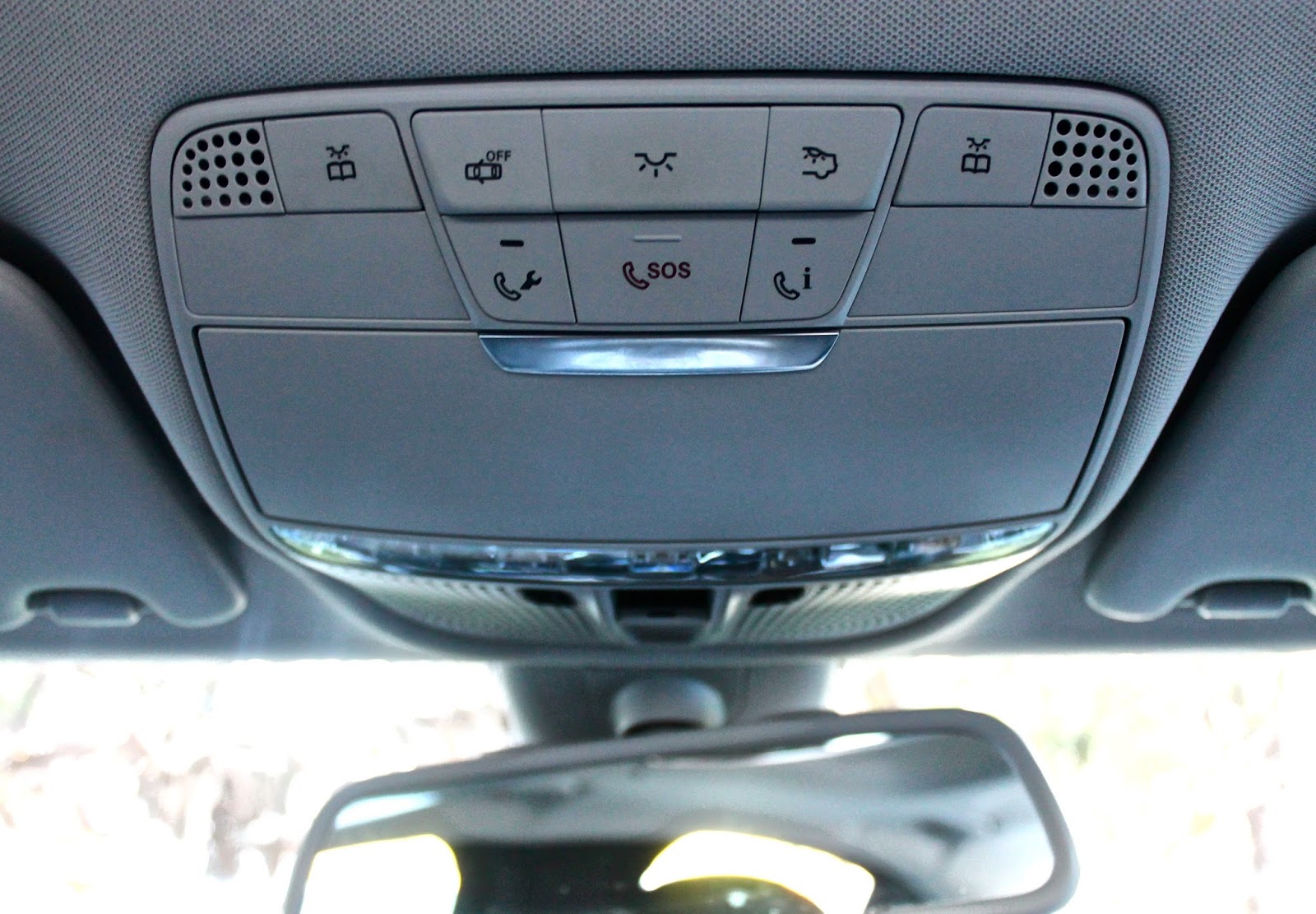
Above the COMAND system control pad was piano black section that contained a hidden cubby, a series of switches and buttons, the CD slot, and the air conditioning vents. The silver plastic switches contrasted well against the shiny black trim piece, and felt solid when pushed. The three circular vents are easily adjustable and look phenomenal--they are almost reminiscent of the front of a propellor airplane. 

The placement of the touchpad means that there isn't space for a conventional gear knob. Instead, gears are changed via a stalk behind the steering wheel. This different method of switching in and out of "Drive" was initially very disorienting--at first I would reach for a traditional shifter and come up with nothing but air. However, I grew used to it, and actually came to like it since shifting into "Park" required simply pushing a button. The steering wheel in front of this stalk was well-sized, and the button layouts only included the most important functions. The gauge display behind the wheel was clean and easy to read while driving.

Perhaps one of my favorite things about the interior of the C-Class were the adjustable seats. Detailed controls, in the shape of seats, are situated just above the door handles. This type of control allowed for a wide range of adjustments, in terms of which part of the seat needed adjusting and how much it needed to be changed.

The backseats weren't quite as luxurious as the front buckets. While there was ample headroom and a solid amount of legroom, the materials felt overall slightly cheaper. The large silver trim piece on the doors felt quite empty, and the plastic-leather around the vents felt inexpensive. My only other complaint about the C-Class was its sound system, which overall felt tinny; electric guitar-heavy songs sounded very thin while the bass was barely distinguishable when listening to bass-heavy tracks.

The C-Class made up for that by being an absolute hoot to drive. The 241 hp turbo inline-four provided the sedan with zippy pickup. While it's no C63 AMG V8 powerhouse, the straight-four even emitted a pretty satisfying growl when I floored the accelerator. The steering felt heavy, but in a assertive, perhaps German, way that made me feel very confident in my ability to control of the car. The C-Class felt very nimble when making turns, and combined with the assertive steering, I felt I was able to enter corners a few miles per hour faster than I might have in my family's 2003 VW Passat or a 2014 Honda Accord. Overall, the ride was very soft and smooth--I felt virtually zero bumps while driving the Merc. The seats were extremely comfortable, hugging my body when I dove into turns. The only issue I found when driving the C-Class was in using the turning signal stalk. Pushing it down or up felt like it took far more effort than usual. Other than this minor problem, driving this beautiful, luxurious sedan was an absolute joy.


Grade
Front: A
Back: A
Overall Exterior: A

Front Seats: A
Rear Seats: B+
Overall Interior: A- 

Driving: A


Tuesday, September 15, 2015

European Vans: Part 2

In my last blog, I analyzed some of the vans that I saw on my recent trip to Italy. Here, in Part 2, are the rest:

Renault/Nissan/Opel/Mercedes-Benz
A Renault Master in Sorano
A Nissan NV400 in Verona
Call it the Renault Master, call it the Opel Movano or even Nissan NV400, but by any name, this van still is a bit gawky and awkward. All three are identical and simply rebadged under different names (with a fourth, the Vauxhall in the U.K.); their most prominent feature in the front are the vertically oriented headlights, which look as if they are being pulled upwards by a string attached to the top of the unit. From the side, the headlights are reminiscent of the oversized headlights on the Chevy Spark compact car. These large headlights make the van appear unusually tall, and sometimes a bit unstable, as if a strong gust of wind could blow the top-heavy vehicle over. The headlights on the Nissan are a bit shorter, but the effect remains. The main difference between the three is in the grilles. The Renault grille has three horizontal bars painted in gray, each with four evenly spaced, rectangular holes. The color and the design have a very industrial feel, and give the van a fittingly tough appearance. The Nissan features the corporate grille, which is not nearly as handsome as the Renault, although it is better than the Opel, which has a lackluster chrome bar atop a black mesh grille. 

A 2nd generation Vivaro in Massa Marittima
(I'm not going to discuss the Mercedes-Benz Sprinter, the other competitor in this segment, because it is also sold in the US.) 

A 3rd genereation Vivaro in Venice
Below the Master/Movano/NV400 is the Renault Trafic/Opel Vivaro. Most of the Trafics and Vivaros that I saw were the second generation model, which looks like an alien with its slanted front and large circular headlights that dwarfed the tiny grille. However, there is a much more attractive third generation model that I spotted a few times. While the headlights are still oddly shaped, they are aggressively angled, and connect to the large, bold grille. On the Renault, the grille is all black with horizontally oriented slats. The Opel is a bit more luxurious, with thin chrome horizontal bars. The lower front fascias are also quite different, with the more utilitarian Renault getting a large black plastic bumper, and the upscale Vivaro getting a wide lower intake and shiny black fog lamp housings. On both vans, a very strong character line extends down from the window and runs along the side panels. While not necessarily the most attractive vans, these two cargo-haulers feature a bold and interesting design. 

Vito in Grosseto
In the Mercedes lineup, the Vito slots beneath the Sprinter. The most expensive, and best-looking, passenger version is the V-Class, and it comes with LED lights and chrome-covered front and rear fascias. A cheaper passenger version, called the Vito Tourer is also offered, with basic head and taillights, and on the cheapest trims, an ugly black plastic front bumper. The cargo version, called simply the Vito, features the same plastic bumper as the Tourer, however, it looks a bit more appropriate on the Vito since it is a work vehicle. Whether or not it has the bumper, all of the Vito/V-Class vans look handsome. Every element is proportioned well, and the headlight shape, which is in line with the rest of the Mercedes family, is unique compared to other vans as well as being pleasing to the eye. Strong creases through the door handle and down the side complete the sturdy and striking appearance of the Vito.
Vito Tourer in Florence


For those who need a slightly smaller van, Renault and Mercedes teamed up for the Kangoo and Citan, respectively. Up front, the Renault has simple, round headlights and a black plastic fascia. Chrome inserts and a large silver logo finish off the basic front end. Only the lower front fascia on the Merc is coated in black plastic, lending the van a slightly more luxurious look. A substantially sized grille gives a bolder look to the Benz, but from there back it is nearly identical to its French counterpart. These two vans come in three sizes: compact, long, and extra long. While compact and long look normal, extra long ruins the proportions of the vehicle, distorting the cute appearance of this little van.

In this segment, Opel offers the Combo, which is a rebadged Fiat Dobló. For more on this vehicle, see my previous post on European vans. Nissan's offering in this segment is the NV200, which is sold in America, and is the new staple of New York's taxi fleet, replacing the Ford Crown Victoria.

Volkswagen

Crafter in Florence
At the top of VW's commercial vehicle range is the Crafter, which is based on the Mercedes-Benz Sprinter. However, it has a completely unique front, with tall headlights and a wide grille with three horizontal bars. Like most VWs, the Crafter has many straight lines, and looks handsome, but the way the grille juts out and the way the vertical headlights flow into the hood create a unique front fascia. 

Multivan in Florence
Beneath the Crafter is the T Series, which consists of the Transporter, Multivan, Caravelle, and California. While the  6th generation just debuted, I'm going to focus on the 5th generation models, which is what I saw on the streets of Italy. The Transporter is the most utilitarian van in the range, and is offered in both passenger and cargo versions. The black plastic bumper differentiates it from the other models. The Multivan and Caravelle are more passenger-oriented vehicles, while the California is a full-fledged camper van. All four models feature the same simple rectangular headlights and thin rectangular grille. Despite how simple the VW's front fascia is, they are quite handsome vehicles, and look especially cool with the optional two-tone red and white paint job.

Caddy in Florence
The Caddy, VW's smallest van, also recently got an update, but since it was not yet for sale, I will focus on the pre-facelifted version. While the taillights look really out of date, the headlights and grille provide the classic VW look: as if it was designed using only a ruler. While not exciting, it is predictable and decent looking. 


Dacia
While I was unable to capture a photo of it, I did see a handful of Dacia Dokkers. The Dokker looks awfully similar to their minivan offering, the Lodgy, with it's pointy headlights and wide grille. It came as a passenger and cargo van, as well as a pickup truck. Like all Dacias, it was incredibly simple, and the front fascia was masked in black plastic. However, the triangular headlights added some character the van. 


Hyundai
I saw one Hyundai H350, and it was parked in front of a Hyundai dealership. While sales appear to be slow, it is not a bad looking vehicle. Bold headlights with straight edges and LEDs stand out, and look relatively aggressive. The extremely large grille is also a plus. Although I only one, this is one of the better looking vans that I spotted in Italy. 


And one final note: I did see one American van while in Italy. It was a grey post-facelift Chevy Express, and looked really out of place among the sleek European vans. You can spot it in the background of the photo of the Mercedes Vito.


Friday, September 13, 2013

2013 US Open


I was sitting in the front seat of a 2014 Mercedes-Benz CLA45 AMG, pushing buttons and stroking leather armrests when I felt a raindrop fall through the open sunroof. As the rain began pouring down, the Mercedes-Benz representative closed up the skylight and the stand. But the hours during the rain delay allowed me to explore some of the interiors of the other cars on display at the 2013 US Open.

2014 Mercedes-Benz E63 AMG
      Stepping into the E63 felt like I was stepping into a work of art. The cabin was almost completely covered in Black Nappa leather, which felt extremely soft and of the highest quality. Sitting inside it, wrapped up in the smooth seats, I felt very disconnected from the world outside the car, as if I were in a cocoon of luxury. The sophisticated interior was accented with chrome pieces and Burl Walnut Wood.
      The center console was adequate, but it was finished in a piano black surface, which may look fancy but smudges easily. Worse, the analog clock sandwiched in between the air conditioner vents was cheap and flimsy looking.  One detail that I particularly enjoyed was the AMG seal stamped onto the gearshift. I also had fun playing with the center compartment, which had two doors that swung open at the push of a button. It was overall a very luxurious and beautiful interior, and my only real issue was a cheap clock.


2014 Mercedes-Benz CLA45 AMG
     After bathing in the expensive leathers of the approximately $90,000 E63, the $56, 000 CLA45 felt considerably less luxurious. There were more plastics throughout the cabin, and the leather surfaces weren't as upscale feeling. The very pretty dashboard looked like it had been blown into its current shape, except I thought the placement of the screen, sticking up on top, was weird because it couldn't be folded down when not in use, which took away from the aerodynamic appeal of the dash. One detail that I really thought was a nice touch were the air conditioning vents, three of them, right below the screen in the center console. The four separators reminded me of airplane propellers, and I'm a big fan of airplane design elements appearing in cars. I also loved the rectangular hole that separates the headrest from the front seat, because I felt like it kept the theme of flowing air that is emphasized in the dash. In the backseat, the cup holders sprung out of the fold down center area with the push of a button. While it wasn't as nice as the more expensive E63, I thought it was overall a very beautiful design and a good interior for the money.


2013 Smart Fortwo Brabus Tailored
    Since Samrt is owned by DaimlerAG, who also owns Mercedes-Benz, therefore a Smart stand is present at the US Open, showing off the not-so-new Smart Fortwo. The first Smart car I sat in was the Smart Fortwo Brabus Tailored, which is designed in collaboration with Brabus, an aftermarket tuning company. This was probably the best-looking Smart interior I've ever been in, and the light brown pleated leather looked very nice. There were, however, a few issues I had. The first and foremost was how disproportionate the leather was placed throughout the cabin. The seats and doors are swathed in the stuff, while there is practically none on the dashboard. Also the cheap black plastic on the dash didn't contrast well with the rest of the car, making it seem as if the designers were too lazy to think of a unique dashboard. Also, I felt that while the interior was very unique, the exterior looked pretty much like every other Smart Fortwo,  which took away from the special feel of the car. Another small quip I had was the storage flap on the bottom of the door (it is mostly blocked by the seat in the photo), which felt very cheap and flimsy and incapable of holding much. While the Smart Fortwo Brabus Tailored's interior is unique, an unfinished dashboard and a boring exterior make it feel cheaper and more ordinary.


2013 Smart Fortwo Electric Drive
     The final car I sampled was the Fortwo Electric Drive, an EV version of the well-known Smart car. On the exterior, the vibrant green paint nicely contrasted the white body paint, but when I stepped inside, I immediately noticed something horribly wrong. While Smart did a nice job using green, commonly associated with EVs, on the outside, the designers had seemed to have forgotten about  the interior. Except around the gauges, green was absent from the cabin; the black interior instead being contrasted with an ugly, cheap, and boring silver plastic. If the bright green had been put on the steering wheel
 , door handles, around the radio, and instead of all the silver bits, it would have enhanced the Electric Drive's interior greatly. If this had been done, I would have really enjoyed the Smart Fortwo Electric Drive, and might have spent more than three minutes in it. (Side note: While not a bad thing, the gauges reminded me of those on the Mini Cooper Hardtop).