Showing posts with label interior. Show all posts

Friday, March 11, 2016

DRIVEN: Mercedes-Benz C300

As we stood at the faux-wood desk in the noisy airport, I flipped through the rental agency's book that showed each of their offerings. I had just found out that our rental car was going to be a Toyota Camry--not the most exciting choice. As I turned the pages I pestered my dad about renting the least practical, and therefore coolest, cars I could find: Corvettes, Mustangs, and G-Classes. He ignored my suggestions and continued working out the details with the attendant. However, I then came upon the C-Class, and suggested this to my dad, with the preface that it is a relatively sensible family sedan. Amazingly it worked, and we soon had the keys to a Mercedes in hand. For one week our daily driver was a car adorned with the famous three-pointed star, and I was able to take a close look at both the interior and exterior design, as well as get a chance to take it for a quick spin.

The majestic Mercedes-Benz S-Class (W222 in Merc-code) debuted for the 2014 model year, and it showed off the German carmaker's new design language. The new look pioneered by the luxo-barge has trickled down to Mercedes's less expensive options, including the C-Class. Many have called the C-Class a clone of the S-Class, and the two cars can be difficult to tell apart from a distance. While the C-Class's looks are derivative, when viewed on its own, it is a drop-dead gorgeous sedan, even in base C300 spec. 

Since our C-Class was a rental car, it came in the most basic form possible, the C300 trim level with no optional packages. Even without the intricate, optional LED headlights, the Merc has a handsome face. Curved headlights aggressively point inwards and slightly downwards. The inside line of the headlights follows the outside edge of the elegant grille. A large logo sits dead center, with two upscale, chrome wings extending out from either side. The grille sits farther out than the headlights, causing the center of the logo to almost appear to be the beginning of the vehicle, and that the rest of the car extends backwards from that point. Beneath the main grille sits an upside-down trapezoidal mesh grille, which is flanked by sporty vents. The black latticework on these lower intakes creates an athletic look, which is accentuated by a comfortable, yet capable, looking stance. Angry creases flow over the tops of the vents into the lower grille, and swooping character lines extend back along the headlights and into the side panels. The chrome strip beneath the lower grille and the extra, small Mercedes logo on the hood round out the opulent look of the front of the C-Class.

A crease extends down the middle of the hood from the logo to the windshield, while other lines stretch back to the A-pillar. Piano black B-pillars and a chrome window outline carry the upscale appearance to the side of the sedan. Expressive, nearly-horizontal character lines run from the front fender to the rear wheels. Speaking of wheels, the C-Class's hubcaps feature a five-spoke, silver design, with each spoke having a hollowed out center. These large hubcaps stand out, and give the Mercedes a brawny attitude. 

The lower character line continues on the other side of the wheel well, and flows seamlessly to form the bumper. The plunging vertical taillights sweep downwards alongside the outline of the trunk, creating a coherently designed rear end. A chrome bar stretching across the trunk and the shiny strip and chrome exhaust pipes on the lower bumper add a touch of luxury to the Merc's back.

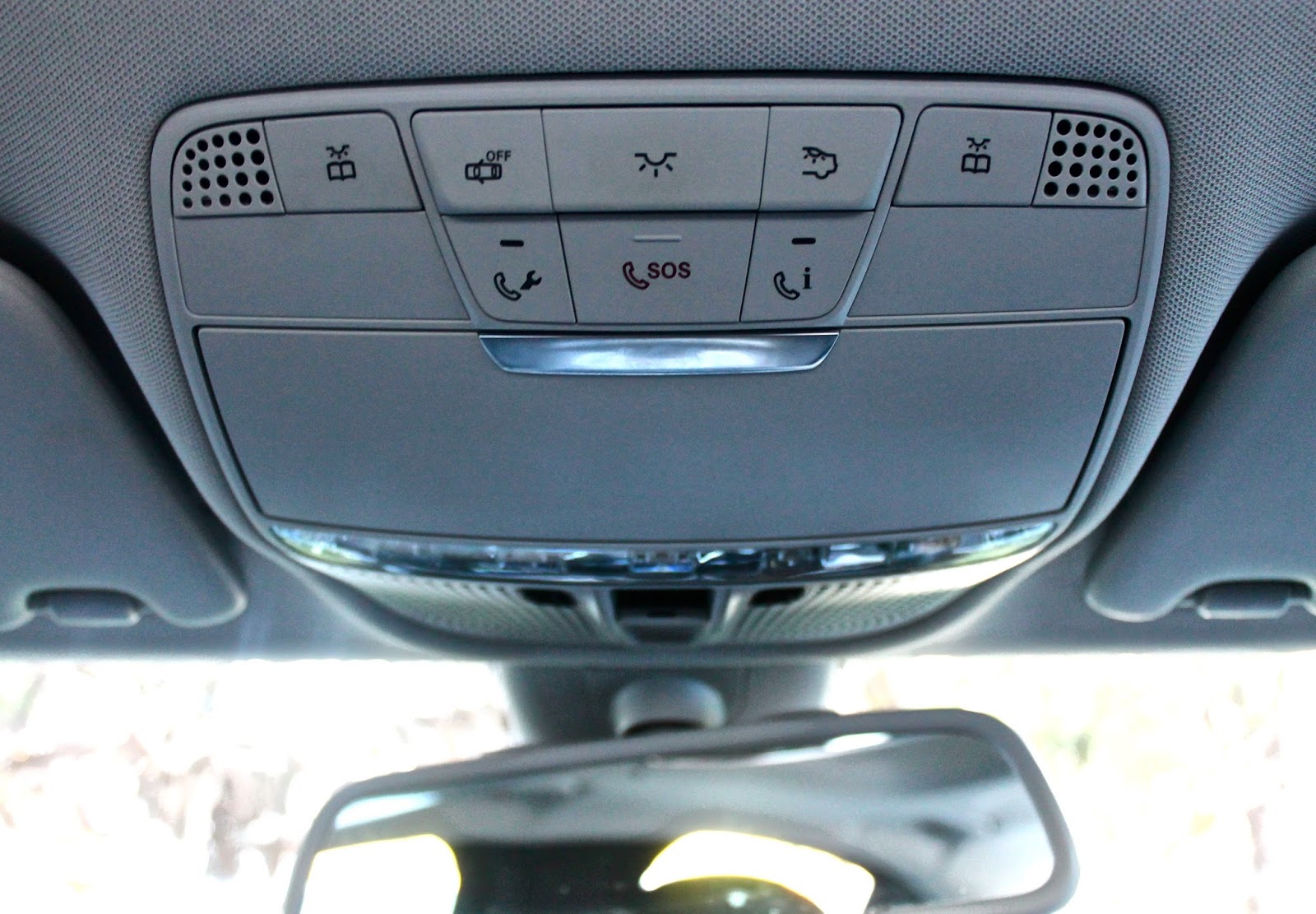
Inside, the Mercedes-Benz is a class act: both stylish and easy to use. The doors close with authority, and the sills feature chrome "Mercedes-Benz" branding. The center console features Merc's COMAND infotainment system, which includes a iPad-like screen, and, where a gear shifter would have normally belonged, a touchpad atop a knob. Our car did not come with navigation, so the infotainment system was used for music alone. The touchpad and knob were fairly easy to use--the pad recognizes north-south-east-west swipes, and can be clicked to select items on the screen. It was quite similar to using a modern smartphone, and looked sleek and stylish as well. The digital layout on the screen was clean and well organized; however, it featured pale yellow accents, which looked cheap.

Above the COMAND system control pad was piano black section that contained a hidden cubby, a series of switches and buttons, the CD slot, and the air conditioning vents. The silver plastic switches contrasted well against the shiny black trim piece, and felt solid when pushed. The three circular vents are easily adjustable and look phenomenal--they are almost reminiscent of the front of a propellor airplane. 

The placement of the touchpad means that there isn't space for a conventional gear knob. Instead, gears are changed via a stalk behind the steering wheel. This different method of switching in and out of "Drive" was initially very disorienting--at first I would reach for a traditional shifter and come up with nothing but air. However, I grew used to it, and actually came to like it since shifting into "Park" required simply pushing a button. The steering wheel in front of this stalk was well-sized, and the button layouts only included the most important functions. The gauge display behind the wheel was clean and easy to read while driving.

Perhaps one of my favorite things about the interior of the C-Class were the adjustable seats. Detailed controls, in the shape of seats, are situated just above the door handles. This type of control allowed for a wide range of adjustments, in terms of which part of the seat needed adjusting and how much it needed to be changed.

The backseats weren't quite as luxurious as the front buckets. While there was ample headroom and a solid amount of legroom, the materials felt overall slightly cheaper. The large silver trim piece on the doors felt quite empty, and the plastic-leather around the vents felt inexpensive. My only other complaint about the C-Class was its sound system, which overall felt tinny; electric guitar-heavy songs sounded very thin while the bass was barely distinguishable when listening to bass-heavy tracks.

The C-Class made up for that by being an absolute hoot to drive. The 241 hp turbo inline-four provided the sedan with zippy pickup. While it's no C63 AMG V8 powerhouse, the straight-four even emitted a pretty satisfying growl when I floored the accelerator. The steering felt heavy, but in a assertive, perhaps German, way that made me feel very confident in my ability to control of the car. The C-Class felt very nimble when making turns, and combined with the assertive steering, I felt I was able to enter corners a few miles per hour faster than I might have in my family's 2003 VW Passat or a 2014 Honda Accord. Overall, the ride was very soft and smooth--I felt virtually zero bumps while driving the Merc. The seats were extremely comfortable, hugging my body when I dove into turns. The only issue I found when driving the C-Class was in using the turning signal stalk. Pushing it down or up felt like it took far more effort than usual. Other than this minor problem, driving this beautiful, luxurious sedan was an absolute joy.


Grade
Front: A
Back: A
Overall Exterior: A

Front Seats: A
Rear Seats: B+
Overall Interior: A- 

Driving: A


Saturday, August 23, 2014

Nissan Altima 2.5 S

      The Nissan Altima 2.5 S is a boring car to look at.  Sure, it takes you where you want to go-- last year, on my family's vacation to Alaska this popular midsize sedan proved to be a very capable sedan for our 1,500 mile driving trip-- but there was nothing impressive visually on either the inside or the outside.
      It starts with the disappointing front fascia. The headlights have a very smooth and elegant outline, but the actual headlamps themselves appear as a jumbled mess of contrasting straight and curved lines. The grille's shiny chrome surround and three horizontal bars are fine but it feels a little small, creating a slightly cheaper look.  The Altima also looks quite cheap on the lower front fascia. The fog lamp housings have no fog lamps (the housing is there for more upscale Altima models), and instead have a flimsy looking plastic cover. This is a common problem when car companies get into cost-cutting measures--it always shows and it always looks awkward.
    The lower grille and intakes look fairly lackluster because of the plastic body colored cross-bars. One detail that works is the character line from the headlights which dips down and curves underneath the lower grille, creating a U-shape. Also the power bulge and creases on the hood  add an athletic vibe to the sedan. Still, these few small positives can't outweigh the cheap look that pervades the front.
     Around back, the taillights are actually quite nice--they are very detailed and it almost feels as if you're looking at a cross section of the taillight. The only complaint could be that they look a little robotic, and that look could be considered a little juvenile, but I don't mind it. The rest of the rear has nothing remarkable about it, although the dual exhaust pipes add a slightly sporty appearance. The short rear deck makes this car feel a little smaller than a midsize sedan (Actually, when I was little I thought the Altima competed in the compact segment).
      Inside is more of the same: a boring and slightly lackluster design that isn't particularly appalling or enthralling. Our car had a grey and black interior, and these drab colors might have contributed to how unexciting the interior appeared. I like the three circular air conditioner vents at the top of the center stack, but the rest seems over-cluttered by buttons, and I found the orange color of the radio screen especially gross. While not very pretty, the storage bins, beneath the center console and behind the gearshift), were useful. The steering wheel was ugly and bland, while the gauges and gearshift weren't bad. In the backseat I had a few complaints. While the seats were comfortable, I felt a little cramped for headroom. I also thought the fold-down bit of the middle seat could've also held a storage bin, instead of all the unused space.

 Grade
Front: C
Back: B
Overall: C+


Tuesday, November 5, 2013

Chevy Impala LT

Impala on 8th Ave. in Brooklyn
      When my mom rented a Chevy Impala I was both excited and dismayed. I was dismayed because in my opinion, it is a horribly designed vehicle, but I was excited because I had never been in one, and I couldn't wait to get to experience its terribleness. Here's my review on one of the most bland and boring vehicles of the last decade.
       The Impala competes against the division of full-size cars that include the Ford Taurus, Hyundai Azera, Kia Cadenza, Toyota Avalon, and Nissan Maxima. All of these cars, while not opulent, are more luxurious and offer more upscale features than the other cars made by their respective companies. The Impala though, does not look fancy inside or outside, and doesn't seem more advanced then the other Chevys.
        Let's begin with the front fascia. The two piece plastic grill is uninspiring, and the closest thing it has to being luxurious is the small chrome trim outlining it. The fat headlights are composed of three circular compartments, which use the basic reflector optics technology instead of a more advanced and better projector lamps. The lower front fascia features uninteresting air intakes, split down the middle by a thin chrome strip. The hood and side panels have absolutely no creases or other interesting bodywork. The hubcaps are a basic five-spoke design, painted in a dull silver. Moving around back, we find basic triangular taillights and that's about it. The license plate is housed in the bumper, which I believe was an immensely bad decision by GM's designers. A better place to put the plate would have been underneath a chrome bar that would stretch from taillight to taillight and have either Chevrolet or Impala etched into it. The one halfway decent thing about the exterior of the car is the spoiler, but even this element has a problem, as it feels out of place because the rest of the car is not sporty.
Impala on 8th Ave. in Brooklyn
         The interior is no better. Since the Impala we rented was a LT (the second most expensive trim), I was expecting a somewhat nice interior, but alas, my dreams were squandered by the drab dash, doors, and seats that awaited me. The black dashboard was trimmed with cheap looking fake wood. On the center console there were an abnormally small amount of controls, making it look empty, as if the designers forgot something. The gear shifter, while one of the better looking interior parts, had a major design flaw-- there were no labels. This made it a bit more confusing while driving. The gauge cluster was unimaginative, just three simple gauges on an flat black surface. The steering wheel in front of it was equally lackluster. The entire wheel was clad in a cheap black plastic-like surface, and sculpted in a fat, inelegant shape. The inside door panels of the Impala LT, were also almost entirely black, with small, shallow compartments sticking out about halfway down. There was one major design element that confused me about the door. Since the faux wood trim was continued around the corner up to the door handle indent, why wasn't more included either along the top of the door or around the rectangular compartments. While the majority of the Chevy's interior looked as if the designers had thought it up while asleep, there was one hint that they were aware it was supposed to be a premium sedan. In the wood trim on the right side of the dash was a small silver Impala logo, with skinny chrome lines extending from it on either side. While this attempt at luxury actually works, it is not enough to set off the rest of the dreary car.


Grade
Front: F
Back: F
Overall: F 


Friday, September 13, 2013

2013 US Open


I was sitting in the front seat of a 2014 Mercedes-Benz CLA45 AMG, pushing buttons and stroking leather armrests when I felt a raindrop fall through the open sunroof. As the rain began pouring down, the Mercedes-Benz representative closed up the skylight and the stand. But the hours during the rain delay allowed me to explore some of the interiors of the other cars on display at the 2013 US Open.

2014 Mercedes-Benz E63 AMG
      Stepping into the E63 felt like I was stepping into a work of art. The cabin was almost completely covered in Black Nappa leather, which felt extremely soft and of the highest quality. Sitting inside it, wrapped up in the smooth seats, I felt very disconnected from the world outside the car, as if I were in a cocoon of luxury. The sophisticated interior was accented with chrome pieces and Burl Walnut Wood.
      The center console was adequate, but it was finished in a piano black surface, which may look fancy but smudges easily. Worse, the analog clock sandwiched in between the air conditioner vents was cheap and flimsy looking.  One detail that I particularly enjoyed was the AMG seal stamped onto the gearshift. I also had fun playing with the center compartment, which had two doors that swung open at the push of a button. It was overall a very luxurious and beautiful interior, and my only real issue was a cheap clock.


2014 Mercedes-Benz CLA45 AMG
     After bathing in the expensive leathers of the approximately $90,000 E63, the $56, 000 CLA45 felt considerably less luxurious. There were more plastics throughout the cabin, and the leather surfaces weren't as upscale feeling. The very pretty dashboard looked like it had been blown into its current shape, except I thought the placement of the screen, sticking up on top, was weird because it couldn't be folded down when not in use, which took away from the aerodynamic appeal of the dash. One detail that I really thought was a nice touch were the air conditioning vents, three of them, right below the screen in the center console. The four separators reminded me of airplane propellers, and I'm a big fan of airplane design elements appearing in cars. I also loved the rectangular hole that separates the headrest from the front seat, because I felt like it kept the theme of flowing air that is emphasized in the dash. In the backseat, the cup holders sprung out of the fold down center area with the push of a button. While it wasn't as nice as the more expensive E63, I thought it was overall a very beautiful design and a good interior for the money.


2013 Smart Fortwo Brabus Tailored
    Since Samrt is owned by DaimlerAG, who also owns Mercedes-Benz, therefore a Smart stand is present at the US Open, showing off the not-so-new Smart Fortwo. The first Smart car I sat in was the Smart Fortwo Brabus Tailored, which is designed in collaboration with Brabus, an aftermarket tuning company. This was probably the best-looking Smart interior I've ever been in, and the light brown pleated leather looked very nice. There were, however, a few issues I had. The first and foremost was how disproportionate the leather was placed throughout the cabin. The seats and doors are swathed in the stuff, while there is practically none on the dashboard. Also the cheap black plastic on the dash didn't contrast well with the rest of the car, making it seem as if the designers were too lazy to think of a unique dashboard. Also, I felt that while the interior was very unique, the exterior looked pretty much like every other Smart Fortwo,  which took away from the special feel of the car. Another small quip I had was the storage flap on the bottom of the door (it is mostly blocked by the seat in the photo), which felt very cheap and flimsy and incapable of holding much. While the Smart Fortwo Brabus Tailored's interior is unique, an unfinished dashboard and a boring exterior make it feel cheaper and more ordinary.


2013 Smart Fortwo Electric Drive
     The final car I sampled was the Fortwo Electric Drive, an EV version of the well-known Smart car. On the exterior, the vibrant green paint nicely contrasted the white body paint, but when I stepped inside, I immediately noticed something horribly wrong. While Smart did a nice job using green, commonly associated with EVs, on the outside, the designers had seemed to have forgotten about  the interior. Except around the gauges, green was absent from the cabin; the black interior instead being contrasted with an ugly, cheap, and boring silver plastic. If the bright green had been put on the steering wheel
 , door handles, around the radio, and instead of all the silver bits, it would have enhanced the Electric Drive's interior greatly. If this had been done, I would have really enjoyed the Smart Fortwo Electric Drive, and might have spent more than three minutes in it. (Side note: While not a bad thing, the gauges reminded me of those on the Mini Cooper Hardtop).


Wednesday, June 26, 2013

Chevrolet Cruze LT


Cruze in Naples, Florida
       On my recent vacation to Florida, my family rented a Chevrolet Cruze LT. This handsome sedan, introduced in 2008, is built on the Delta II platform, which it shares with the Buick Verano, and has an inline-4 under the hood, capable of going 0-60 in 9.2 seconds. Our Cruze was fitted with the RS package, which adds unique front and rear fascias, lower body moldings, and a rear lip spoiler.

          The Cruze's front fascia features angular headlights, which have an elongated look, as the upper left corner is stretched back over the front of the wheel arch, forming a crisp line that flows into the window lining. This make the sedan look aggressive, giving it a sports car feel. The Cruze also features the corporate Chevy two-piece grille. Although its not particularly revolting, I dislike the bar running through the middle of the grill, because it makes the grill feel smaller. The idea of a small grill reminds me of the ugly cars of the 90's and early 2000's, which had useless, miniscule grilles (i.e. Ford Contour). The lower front fascia has fog lamps, surrounded with chrome inserts, which give the car an upscale look. Moving back, a sharp crease runs just above the door handles, and about 6 inches below the window sills, giving the body more texture. The hubcaps, although a pretty basic 5-spoke design, reinforce the Cruze's sporty vibe. At the rear, we have one piece taillights, which have two circles, the outer one larger than the other, which is similar to the two piece taillights of the Camaro or Corvette, or the almost two-piecers of the Malibu and Traverse. A rectangular chrome bar connects the taillights, and the Chevy badge, and Cruze and LT are written above it. While this Chevy is conservatively styled, it is still a good-looking compact.                                                                          
Cruze in Naples, Florida
        Now for the interior. The center console featured silver plastics contrasted by a piano black surface. It is luxurious looking but can be annoying as it smudges and shows fingerprints easily. The infotainment screen was of a decent size, and worked fairly well, although we didn't use it that much. My only complaint was that sometimes it felt as if it was too backlit, that there was too much exposure. The majority of the buttons, dials, and switches were easy to use, and the hazard button and the AC dials were very easy to find.

The steering wheel has a somewhat clean design, with only a moderate amount of buttons and a basic layout. The instrument cluster is also very basic, although the center gauge could've been put to better use, for a larger speedometer possibly. The seats, while not the most comfortable, were nice enough for an inexpensive compact. The only place where I felt uncomfortable was the backseat. I'm fairly tall, and therefore I felt a lack of headroom (I hit my head into the roof on multiple occasions) and also the seatbelt dug into my shoulder. This made long drives pretty awkward for me, as I had to sit hunched over. Another minor quibble I had was that  the overhead light section in the front had too much empty space, which could've been use for bigger lights, or, as I have seen in cars like the Australian Toyota RAV4, a small, swing-down storage compartment.

        But despite the few minor complaints, the Cruze was overall a very good looking car, because of it's slight sporty feel, and a pretty comfortable car on the inside.

Grade
Front: B+
Back: B

Overall: B+