Showing posts with label Detroit. Show all posts

Thursday, October 27, 2016

Comuta-Car

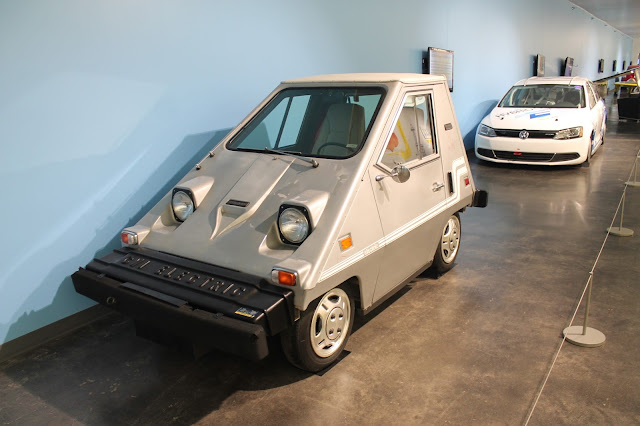
1981 Comuta-car at LeMay-America's Car Museum in Tacoma, Washington
Until 2011, this tin can surprisingly held the record for the most road-legal electric cars sold in post-war U.S. with 4,444 units shifted. Known as the CitiCar, and later the Comuta-Car when the design was purchased by Commuter Vehicles in 1979, this trapezoidal hatchback was powered by a measly electric motor that had a decent range of 40 miles. This alternative powertrain was provoked by the 1973 oil crisis, when gas prices surged and many stations experienced fuel droughts due to an embargo by the member countries of the Organization of Arab Petroleum Exporting Countries. While the Comuta-Car's historical significance is intriguing, its design, especially those of the early 1980's models seen here, is overwhelmingly repulsive.
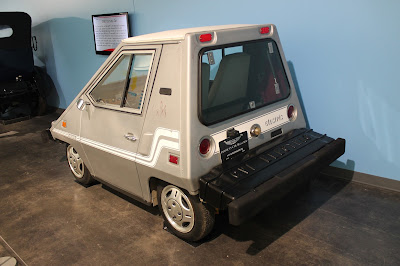
1981 Comuta-car at LeMay-America's Car Museum in Tacoma, Washington
The poor exterior begins simply with the basic shape, which appears to have been designed with a ruler. The hood and windshield angle backwards away from the protruding bumper at a straight incline, before meeting the flat near-square roof. This almost vertically extends downwards out the back and sides, essentially creating a metal box. However, there have been attractive box design before like the spunky, and relatively popular, first generation Scion xB (R.I.P. 2003-2016) and the Nissan Cube. Yet the Comuta-Car's few exterior doodads just make it an even more hideous beast.

The most glaring offenders are the oversized bumpers. These massive plastic appendages hang off either end of the car and were added to meet more stringent safety regulations. (Further safety requirements would prove to be the demise of the small company.) While all U.S. market cars between 1973 and 1982 suffered from these bulbous bumpers, they look significantly larger, and therefore worse, on the Comuta-Car because it is so short to begin with.

Moving back, the hood features one of the other prominent design flaws. Rising out of the flat bonnet is a rectangular bulge, which does not appear to be functional. This protrusion is a pointless, odd-looking, and not very aerodynamic addition, disrupting what would have otherwise been a smooth hood. The roof, which appears to be vinyl, is also unattractive, making the car look cheaper. Vinyl roofs are also very prone to sun damage and tend to fade, crack, and peel.
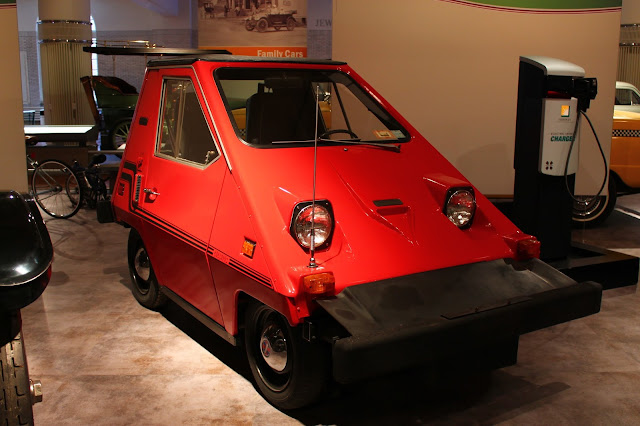
1980 Comuta-car at The Henry Ford Museum in Dearborn, Michigan
The bumpers, hood bulge, and vinyl roof all make the Comuta-car look insanely cheap, but what puts the bolt in the coffin are the visible bolts holding the car together. If you look along the sides of the hood and down the rear of the car, you can see where the different metal sheets were fastened together, which makes the car look unsafe, as if it's all about to fall apart into hundreds of little pieces. The car's one saving grace is the wacky paintjob, while consists of very '70s stripes and the lowercase word "electric." Other than these laughable but cool decals, the Comuta-car is a truly ugly car, even when compared to the myriad of unattractive cars from the design dark ages that were the late 1970s, 1980s, and 1990s.

Grade
Front: F
Rear: F
Overall: F

Saturday, August 27, 2016

Hood Ornaments Part 2

From the earliest days of the automobile, the hoods of many cars, especially luxurious models, were adorned with exquisite figurines. Hood ornaments are now largely a thing of the past, and several months ago I wrote a post celebrating this lost art. Today I bring you four more beautiful hood decorations.
2013 Mercedes-Benz S-Class in Key West, FL
While simple, the Mercedes-Benz hood ornament has turned the logo into a icon. This example is seen on the bonnet of a 2013 S-Class sedan, and while the ornament is just the Merc emblem atop a small column, it screams luxury and authority. This legendary logo is now only found atop the flagship S-Class sedan. 

1931 Bugatti Type 41 Royale at the Henry Ford Museum in Dearborn, MI
The Bugatti Type 41 Royale debuted just as the Great Depression sent the world into financial ruin. Therefore, its already exclusive run of 25 units was cut to just six, and only three examples made it into the hands of owners. One of the three sold currently resides at the Henry Ford Museum, and it only makes sense that such a special car has such an unusual and intricate hood ornament. The grille of the Royale is topped with a elephant standing on its hind legs, trunk raised triumphantly in the air. This sends off an image of rarity and opulence, as well as power. This is one of the most unique and ornate hood ornaments of all time.

1935 Miller-Ford Indy 500 racer at the Henry Ford Museum in Dearborn, MI
Surprisingly, back in the 1930's even Indy 500 competitors had hood ornaments. Unfortunately this Miller-Ford never ended up being raced at Indianapolis, despite the team's best efforts. However, it does feature an elegant version of Ford's 1930's V8 hood ornament. I've always liked the way Ford sandwiched the 8 between the arms of the V, and the wing flowing backwards conveys a sense of speed--perfect for a race car.

Jaguar S-Type in Key West, FL
Another one of the most recognizable hood ornaments are perched on the hoods of Jaguars. Seen here on a S-Type, the jaguar is springing forward, its muscular haunches and lean physique bristling with energy. With a ferocious scowl and piercing eyes the predator strikes fear in the hearts of surrounding drivers.


Sunday, March 22, 2015

Ford F-150

F-150 Platinum at The Henry Ford in Dearborn, Detroit
     When Ford pulled the wraps off the Atlas Concept at the 2013 Detroit Auto Show, all media attention was diverted in the Blue Oval's direction. The bold concept previewing the next F-150 easily outshone Chevy's new Silverado and all the other world debuts. So the next year when Ford unveiled the production F-150 in the Motor City expectations were exceedingly high. Ford delivered and more. The truck featured many of the Atlas' aggressive design cues that had generated such hype as Ford converted the outlandish styling of the massive Atlas into production-friendly design. I almost feel like I am promoting Ford but the praise is deserved: the F-150 is the best looking full-sized pick-up truck in the game.
Lariat at NYIAS
     Starting at the front, it is immediately obvious that this truck means business. The sideways U-shaped headlights look robotic, almost reminiscent of Iron Man, and the LEDs on the Platinum model add a modern touch while also being more efficient and brighter than normal headlamps. While the other model pictured, the Lariat, doesn't have LEDs, the sharp-edged headlights still appear intimidating. Both models feature huge chrome grilles: the Platinum features three thick bars with skinny rectangular cutouts within these bars; the Lariat's grille is composed of slightly more pedestrian chrome bars without the chrome filling. Nonetheless, these opulent grilles show off the F-150 as a luxury vehicle, a growing trend among full-size trucks. Each truck's lower front fascia also has a healthy dose of chrome, as well as tough, square fog lights.
      Powerful hood creases lead back to massive sideview mirrors, the Platinum, of course, is dripping with chrome. The mirrors feature the extremely useful Spotlights, which illuminate the area surrounding the truck for easy night working. The F-150's only design flaw appears along the side, where the front window dips down, the soft curve in contrast with the hard-edged styling of the rest of the pickup. Out back on the Platinum, a thick, silver bar connects LED taillights. This combined with the model name being stenciled into the bar further strengthens its dynamic image. The Lariat, a cheaper trim level, is a bit too plain, although it still retains the stylish taillights.
Lariat at NYIAS
     The Spotlights mentioned above are just one of many cool features on the F-150 that make work more convenient. There is also LED lighting in the bed and near the trailer hitch, as well as power-deployable running boards, box side steps and a tailgate step. All of these accessories make the cabin and bed easier to get to and load or unload, make sure that while the truck aspires to be a luxury vehicle it retains its place as the premier workhorse on the market. 

Grade
Box Side Steps on Platinum at The Henry Ford in Dearborn, Detroit
Front: A
Back: A-
Overall: A