Showing posts with label 1980's. Show all posts

Sunday, November 6, 2016

BMW E24 6 Series

1987 BMW L6 in Baruch Houses in the Lower East Side, New York, New York 
In 2004, BMW resurrected the 6 Series nameplate on a slinky coupe which was adapted from the Z9 Concept. Designed when Chris Bangle was BMW's chief of design, the 6 Series' controversial exterior featured a bulbous rear end, squinty, upturned headlights, and snout-like grille. While certainly striking, the reborn E63 6 Series wasn't reminiscent of the aggressively handsome original. Introduced for the 1977 model year, the E24 6 Series replaced the CS coupe (which had spawned the legendary 3.0 CSL), and with its "shark-nose" styling the E24 is an imposing presence.

The 6 Series's good looks are entirely due to the front-end styling. The sharp forward-leaning grille and headlights give the impression that the BMW is charging forward, slicing through the air. This windswept look gives the coupe visual speed and a healthy dose of attitude. Like all '70s and '80s Bimmers, the twin headlights are integrated into black rectangular vents. However, this element looks best on the E24 due to the extremely skinny kidney grille that separates the vents. This causes the 6 Series to look wider than its BMW brethren, even though the width is similar to the 5 Series and far less than the 7 Series of the time.


A thin rectangular hood bulge that rises out of the kidney grille gives the car a powerful appearance. BMW was able to minimize the visual damage of the strict U.S. demands for bumpers by topping them off with chrome. The 6 Series features a subtle beltine, a light crease that flows from the headlights to the taillights uninterrupted. Around back, things are kept simple, with bland, blocky taillights outlined in chrome. The twin tailpipes peek from underneath the bumper, hinting at the 215 horses under the hood. Overall, while the rear fascia is a bit ordinary, the dramatic shark-nose front makes the 6 Series a handsome grand tourer.

Grade
Front: A
Back: B
Overall: A-


Thursday, October 27, 2016

Comuta-Car

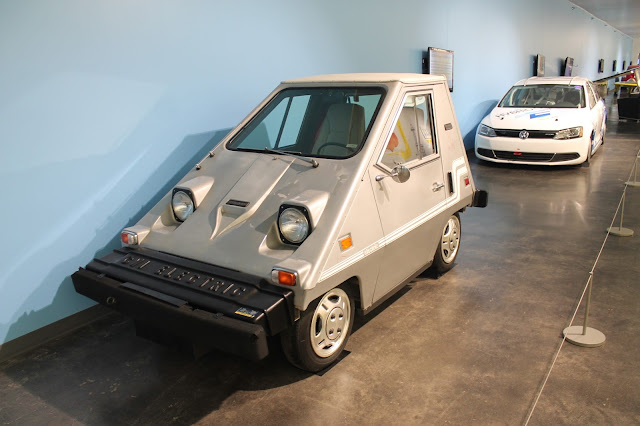
1981 Comuta-car at LeMay-America's Car Museum in Tacoma, Washington
Until 2011, this tin can surprisingly held the record for the most road-legal electric cars sold in post-war U.S. with 4,444 units shifted. Known as the CitiCar, and later the Comuta-Car when the design was purchased by Commuter Vehicles in 1979, this trapezoidal hatchback was powered by a measly electric motor that had a decent range of 40 miles. This alternative powertrain was provoked by the 1973 oil crisis, when gas prices surged and many stations experienced fuel droughts due to an embargo by the member countries of the Organization of Arab Petroleum Exporting Countries. While the Comuta-Car's historical significance is intriguing, its design, especially those of the early 1980's models seen here, is overwhelmingly repulsive.
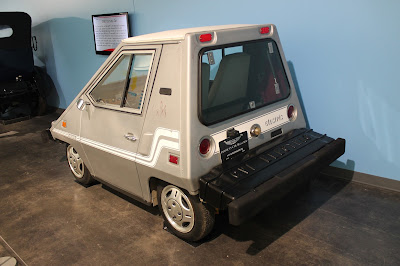
1981 Comuta-car at LeMay-America's Car Museum in Tacoma, Washington
The poor exterior begins simply with the basic shape, which appears to have been designed with a ruler. The hood and windshield angle backwards away from the protruding bumper at a straight incline, before meeting the flat near-square roof. This almost vertically extends downwards out the back and sides, essentially creating a metal box. However, there have been attractive box design before like the spunky, and relatively popular, first generation Scion xB (R.I.P. 2003-2016) and the Nissan Cube. Yet the Comuta-Car's few exterior doodads just make it an even more hideous beast.

The most glaring offenders are the oversized bumpers. These massive plastic appendages hang off either end of the car and were added to meet more stringent safety regulations. (Further safety requirements would prove to be the demise of the small company.) While all U.S. market cars between 1973 and 1982 suffered from these bulbous bumpers, they look significantly larger, and therefore worse, on the Comuta-Car because it is so short to begin with.

Moving back, the hood features one of the other prominent design flaws. Rising out of the flat bonnet is a rectangular bulge, which does not appear to be functional. This protrusion is a pointless, odd-looking, and not very aerodynamic addition, disrupting what would have otherwise been a smooth hood. The roof, which appears to be vinyl, is also unattractive, making the car look cheaper. Vinyl roofs are also very prone to sun damage and tend to fade, crack, and peel.
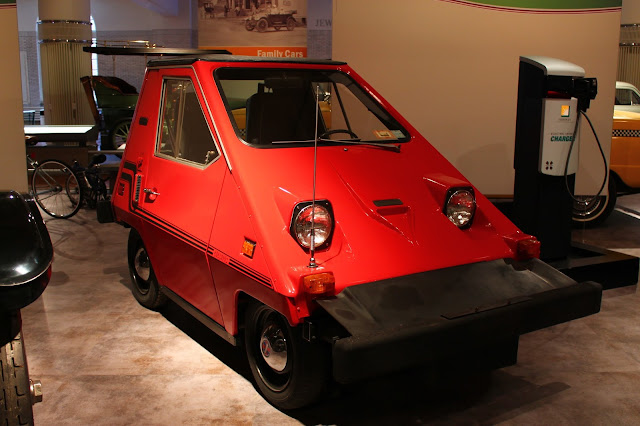
1980 Comuta-car at The Henry Ford Museum in Dearborn, Michigan
The bumpers, hood bulge, and vinyl roof all make the Comuta-car look insanely cheap, but what puts the bolt in the coffin are the visible bolts holding the car together. If you look along the sides of the hood and down the rear of the car, you can see where the different metal sheets were fastened together, which makes the car look unsafe, as if it's all about to fall apart into hundreds of little pieces. The car's one saving grace is the wacky paintjob, while consists of very '70s stripes and the lowercase word "electric." Other than these laughable but cool decals, the Comuta-car is a truly ugly car, even when compared to the myriad of unattractive cars from the design dark ages that were the late 1970s, 1980s, and 1990s.

Grade
Front: F
Rear: F
Overall: F

Sunday, June 5, 2016

Monday, February 1, 2016

1984 Ferrari Testarossa

The Testarossa is one of Ferrari's most iconic sports cars and one of Pininfarina's best designs. Large posters featuring this flashy coupe covered teenagers' bedroom walls throughout the 1980s and 1990s. The Testarossa has always been one of my favorite cars, even though I had never seen one until this summer. However, while visiting Modena, Italy I had the chance to spend many many hours drooling over the beauties at the local car museums, including the Museo Enzo Ferrari which has this gorgeous red Testarossa in its collection. (Testarossa means "red head" in Italian, and while it refers to the paint on the cylinder heads in the engine, red is certainly a fitting hue for the car.) The next few paragraphs will just be me praising the Testarossa nonstop, so I completely understand if you want to just stare at the photos instead. Anyway, here I go:


The Testarossa is remarkably aerodynamic—its drag coefficient of .36 beat the Lamborghini Countach's .42, and the Countach looks extremely slippery itself. This drag coefficient translates into a curvier variation of the wedge designs of the 1970s, with a dramatically sloped hood stretching back to a low-to-the-ground cabin. Hidden headlights add to the smooth, sexy front end. The thin, rectangular lower grille and running lights emphasizes the wide, athletic stance that makes the Testarossa stand out. The narrow vent just in front of the windshield further accentuates the car's width, and hints at the 390 hp V12 beast lurking behind the cabin that propelled it to 60 mph in 5.3 seconds.

The side view of the Testarossa is dominated by striking side strakes, which cool the engine. The length and horizontal nature of the strakes make the car appear longer and lower, and therefore much faster. They also make the Testarossa instantly recognizable. Above the strakes broad haunches emerge, making the Ferrari look as if it is on the verge of leaping forward even when it is at rest.
The rear fascia expands upon the design of the side strakes. Five thin, black, metal bars stretch from end to end, caging in the taillights and rectangular grille. This highlights the Testarossa's width and causes the Ferrari to look like it is hugging the road. Two sets of dual-exhaust pipes stresses the sports car's performance credentials. The buttresses extend from the roof, causing a smooth, sloping silhouette. The Testarossa is without a doubt one of Pinifarina's masterpieces, and one of the most beautiful Ferraris of all time.

Grade
Front: A
Back: A
Overall: A


Tuesday, June 23, 2015

Callaway C4 Corvette

     At first, it seemed unusual to find this athletic Corvette-based Callaway in a deserted lot next to a roadside fast food restaurant in Texas. But when you look at all the strangely placed vents and other abnormal design cues, the desolate lot is a natural home for this 1980's oddball.

     Up front, the Callaway hasn't been altered that drastically from the normal C4 'Vette, with the biggest change being the addition of functional vents. The intakes were added to boost performance figures, however, most of the added vents hurt the Corvette's sleek styling. The four square holes are reminiscent of nostrils, causing the face of the C4 to look snout-like. While two of the vents are smoothly integrated into the headlight shape, the vertically oriented slats on the hood appear tacked on as an afterthought. Furthermore, the square vent just behind the front wheels is not a dynamic shape, and the thin horizontal bars look like those on an air conditioner.
      While the front is a jumbled mess of air intakes, the rear fascia features a clean, simplistic design. The classic 'Vette double circle taillights have been joined to create smooth ovals, though the circular units can still be spotted within these new lamp designs. The name "Callaway" is indented in a simple but elegant font between the taillights. The biggest modification is the removal of the curved rear windshield, which gave the Corvette a slick fastback silhouette. Without the iconic glass dome, the Callaway resembles the awkward offspring of a sports car and a pickup truck.

Grade
Front: B
Back: B+
Overall: B